Notice: Function _load_textdomain_just_in_time was called incorrectly. Translation loading for the jetpack domain was triggered too early. This is usually an indicator for some code in the plugin or theme running too early. Translations should be loaded at the init action or later. Please see Debugging in WordPress for more information. (This message was added in version 6.7.0.) in /home/urbanana/public_html/wp-includes/functions.php on line 6114

Warning: Cannot modify header information - headers already sent by (output started at /home/urbanana/public_html/wp-includes/functions.php:6114) in /home/urbanana/public_html/wp-includes/feed-rss2.php on line 8
urban insights – Urban Analytics Institute https://urbananalyticsinstitute.com Mon, 29 Jul 2019 18:19:22 +0000 en-CA hourly 1 https://wordpress.org/?v=6.7.5 https://urbananalyticsinstitute.com/wp-content/uploads/2024/08/cropped-1-1-modified-removebg-preview-150x150.png urban insights – Urban Analytics Institute https://urbananalyticsinstitute.com 32 32 Calls for significant changes to our parking standards https://urbananalyticsinstitute.com/calls-for-significant-changes-to-our-parking-standards/ Fri, 26 Jul 2019 22:34:39 +0000 https://urbananalyticsinstitute.com/?p=267 Yemi Adediji from Ryerson University’s Urban Analytics Institute explains why changes need to be made to Toronto’s outdated parking standards.

See video: https://globalnews.ca/video/5487982/calls-for-significant-changes-to-our-parking-standards

Disclaimer and Acknowledgements: This blog post has been reproduced, with thanks, from Global News, published on July 12, 2019.

]]>
Why above-ground parking may be the best bet in the age of self-driving cars https://urbananalyticsinstitute.com/why-above-ground-parking-may-be-the-best-bet-in-the-age-of-self-driving-cars/ Fri, 05 Jul 2019 20:03:42 +0000 https://urbananalyticsinstitute.com/?p=262 Haider-Moranis Bulletin: Because autonomous vehicles will require less space for parking, underground structures could become redundant.

Advances in transportation technology are transforming the way we travel. App-based ride-hailing and car-sharing are just a few examples. In the future, autonomous vehicles (AVs) will revolutionize the very contours of mobility. Not only will AVs be able to drive themselves, but they will also be able to park themselves.

Self-parking vehicles are expected to transform the architectural and structural designs of high-rise buildings. The cumulative effect of mobility innovations will reduce the demand for parking. Hence, if parking standards for new high-rise buildings are not revised, we might end up with surplus underground parking, which may be difficult to repurpose.

A recent report by Ryerson University’s Urban Analytics Institute (of which Murtaza Haider was a co-author) explored the impact of innovations in transportation technology on the future demand for parking. The report observed that the current practice of requiring a fixed minimum number of parking spots in underground lots is likely to result in an eventual oversupply of parking.

Furthermore, minimum parking standards may also be contributing to housing affordability challenges because the cost of an underground parking spot varies between $50,000 and $100,000 in places where land values are high.

Recent research has shown that automobile ownership is lower in high-rise buildings that facilitate carsharing. Furthermore, younger cohorts have readily adopted ride-hailing while exhibiting a lower proclivity for car ownership than older cohorts. A decline in car ownership implies a decline in the demand for traditional parking spaces.

Whereas parking demand is likely to decline in the future, the demand for travel is expected to increase. The counterintuitive assertion stems from the way AVs are likely to operate. AVs may try to avoid expensive parking costs by deadheading back to the origin of the trip or another location offering inexpensive parking. This will result in additional zero occupancy trips that will be an additional contribution to traffic volumes.

Also, AVs will spend more time traveling while they serve the mobility needs of passengers whose trip origins, destinations and trip times vary. Thus, mobility patterns of AVs will have more in common with taxi cabs than the private automobiles that are parked most of the time.

However, that’s not all. Because AVs could communicate with each other, they may be parked in tandem in several rows. When required, AVs will move by themselves to allow other vehicles to leave. Thus, they will require a reduced amount of space for parking.

The construction industry has long been advocating for flexibility in minimum parking standards. The industry contends that providing underground parking is an expensive proposition that raises the price of dwellings in multi-residential buildings. With large cities struggling with housing affordability, the provision of underground parking could impede achieving the affordability goals.

The Ryerson University report recommends that cities consider revising the minimum parking standards in light of the expected decline in the demand for parking space.

Autonomous vehicles may be parked in tandem in several rows. When required, AVs will move themselves to allow other vehicles to leave. Thus, they will require a reduced amount of space for parking

It also suggests building above-grade parking in multi-residential buildings instead of underground parking. “Provision of above-grade parking is less expensive and at the same time allows for the repurposing of parking spaces if space becomes redundant in the future,” the report argued.

The report listed examples of above-grade parking structures repurposed after space was no longer required for parking. In Cincinnati, Ohio, a parking garage was converted to a hotel featuring 239 rooms, an art gallery, and several other amenities. The adaptive reuse of the garage was financially more feasible than a complete teardown.

Similarly, Northwestern University in Evanston, Ill., retrofitted a parking garage to develop an entrepreneurial innovation centre equipped with classrooms and shared meeting spaces.

Because these parking structures were above ground, it was possible to find alternative uses for them. Had this space been underground, repurposing alternatives would have been seriously limited.

Parking structures must be designed to allow for alternative uses in the future. Higher ceilings, gentler sloping slabs, and placement of elevator banks and staircases are some of the design considerations needed for the future transformation of parking spaces.

Skylines in large Canadian cities will showcase many more high-rise buildings in the future. Adjusting parking standards will help future-proof buildings by embracing flexibility in design.

Disclaimer and Acknowledgements: This blog post has been reproduced, with thanks, from The Financial Post’s Haider-Moranis Bulletin, courtesy of Murtaza Haider and Stephen Moranis, published on July 4, 2019.

Murtaza Haider is a professor of Real Estate Management at Ryerson University. Stephen Moranis is a real estate industry veteran. They can be reached at http://www.hmbulletin.com.

]]>
Regulating Vehicles-For-Hire in Toronto https://urbananalyticsinstitute.com/regulating-vehicles-for-hire-in-toronto/ Sun, 23 Jun 2019 17:08:37 +0000 https://urbananalyticsinstitute.com/?p=245 A new report (which can be found here: UAI_VFH_Report_June 2019) by the Ryerson Urban Analytics Institute assesses the regulatory provisions for the Vehicle-for-Hire industry. The report has undertaken a detailed review of the Vehicles-Fore-Hire (VFH) bylaw and contrasted the regulations against the planning goals for mitigating traffic congestion, reducing tailpipe emissions and traffic volumes by automobiles, improving accessibility for passengers with special needs, and improving passenger and traffic safety.

The report concludes that the existing VFH regulations have resulted in outcomes that are not in line with the City of Toronto’s stated goals and priorities such that many of the aforementioned metrics have worsened as a result.

The report offers the following recommendations:

It recommends that the City of Toronto should eliminate discrepancies in regulations that may adversely impact one set of operators while benefiting another. Regulations must be streamlined to improve the well-being of drivers, operators, owners, and, more importantly, passengers.

The report recommends that the vehicle-for-hire regulations should be revised so that the stated policies and priorities for reducing traffic congestion and harmful tailpipe emissions, improving public transit ridership and traffic safety, and improving accessibility for passengers with special needs can achieve their intended goals. Furthermore, given the stated goal to provide fulfilling employment opportunities for all Torontonians, it is incumbent that the City should continue to observe the impact of PTC operations on the welfare of drivers and others involved in the vehicle-for-hire industry.

Lastly, this report endorses the recent recommendations by the City Staff for improving mobility in the City of Toronto. The City staff recommended:

  1. “Transportation Services [at the City of Toronto] to build a monitoring program as part of the Congestion Management Plan to monitor the impacts of Vehicles-for-Hire on VKT, traffic congestion, and GHG emissions and to better understand the relationship with traffic congestion trends in the city.
  2. “Transportation Services to continue to study the impact of Vehicles-for-Hire on the Curbside Management plan and related policies.
  3. “Transportation Services to investigate whether there is a road safety impact of Vehicles-for-Hire and to collaborate with MLS and the Toronto Police Service to collect appropriate data.
  4. “In order to be able to continuously monitor and evaluate the impact of vehicles-for-hire on the transportation network, changes are required to the data currently being collected to include information on PTC volumes, wait times, trip cancelations, deadheading and curbside activity.”
]]>
Housing affordability is getting worse even though prices are falling. How is that possible? https://urbananalyticsinstitute.com/housing-affordability-is-getting-worse-even-though-prices-are-falling-how-is-that-possible/ Tue, 28 May 2019 17:01:43 +0000 https://urbananalyticsinstitute.com/?p=155 Haider-Moranis Bulletin: Housing affordability only partially depends on prices. Regulatory changes, such as the stress test and mortgage rates, play a large role, too.

Conventional wisdom states that falling prices should improve housing affordability.

Though the logic is appealing, Canadian housing markets paint quite a different picture, with housing affordability worsening even though average housing prices have fallen.

Unlike many other assets classes, housing markets are complex and heterogeneous, with no two homes (or buyers) being identical. As a result, the housing market does not necessarily follow the typical wisdom of markets.

Recent housing market data and research reveal that affordability eroded in Canada even as prices have tumbled. The reason for this anomaly is that housing affordability only partially depends on prices. Regulatory changes also play a large role in determining housing affordability.

A report by RBC Economic Research reviewed housing affordability in the third quarter of 2018 and concluded that it was “getting less affordable to own a home in Canada.”

The report tracks the income required to cover the cost of owning an average home with a 25 per cent down payment. When compared with the third quarter of 2015, the qualifying income had increased significantly by the third quarter of 2018.

In Vancouver, for instance, the income required to cover ownership of an average home was $211,000 in 2018, up from $127,000 three years ago. The qualifying income in Toronto was $187,000 in 2018 compared to $103,000 in 2015. In fact, the qualifying income had increased in all large and small housing markets across Canada.

One big reason for the higher qualifying income required in 2018 was the increase in housing prices since 2015, a rise that was most pronounced in Greater Vancouver and Toronto.

Qualifying incomes, therefore, increased by $34,000 in Vancouver and $27,000 in Toronto since 2015 as a result of higher prices, the RBC report estimated.

But rising prices were not the only factor. Even without their impact, the qualifying income would have climbed considerably because of the stress test that required the borrowers to qualify at a higher interest rate than the contracted rate as of January 2018.

The RBC report estimated that the increase in qualifying income due to the stress test was almost the same as the one resulting from the increase in housing prices.

The stress test raised the qualifying income threshold by $36,000 in Vancouver and $27,000 in Toronto.

pastedGraphic.png

Recent housing market data and research reveal that affordability eroded in Canada even as prices have tumbled. Tyler Anderson/National Post files

It also didn’t help that mortgage rates also increased over the same period further raising the bar to qualify for home ownership.

The RBC Economics Report illustrates the peculiarities of housing markets where price alone does not determine the affordability of an asset. Certainly, the increase in housing prices eroded affordability. However, equally instrumental were the regulatory changes (stress test and mortgage rates) that also erected huge affordability barriers.

The impact of the stress test is further illustrated with data from Toronto where housing prices rose sharply from 2015 to the first quarter of 2017. Toronto’s housing market experienced two regulatory shocks. The first shock came in April 2017 when the Ontario government imposed new taxes on foreign homebuyers. The immediate impact was a decline in sales and prices. The second shock came in January 2018 when the stress test was imposed.

Toronto’s sales data reveals that the share of the market taken up by the least expensive homes (those sold for less than $400,000) declined as housing prices increased.

For instance, 30 per cent of the homes sold in 2015 transacted for less than $400,000. By the first quarter of 2017, when housing prices peaked, the share of low-priced homes accounted for a mere 12 per cent of the transactions.

As the housing prices slid in Toronto as of May 2017, the share of homes that transacted for less than $400,000 increased slightly and represented 13 per cent of the total transactions for the rest of 2017.

However, the share of low-priced homes in 2018 declined from 13 to 9 per cent (a 31 per cent drop), which took place even when the nominal average home price in Toronto declined from $822,681 in 2017 to $787,300 in 2018, and $766,197 in February 2019.

Again, the conventional wisdom would have dictated an increase rather than a decline in the share of low-priced homes that attract low- to moderate-income households. But that didn’t happen.

The stress test and the increase in mortgage rates increasingly affected the affordability of low-income households and priced them out of the market even when house prices were declining.

Housing affordability will improve with a decline in home ownership costs, which will require regulatory changes in the short run and greater housing supply in the long run.

Disclaimer and Acknowledgements: This blog post has been reproduced, with thanks, from The Financial Post’s Haider-Moranis Bulletin, courtesy of Murtaza Haider and Stephen Moranis, published on March 13, 2019.

Murtaza Haider is an associate professor at Ryerson University. Stephen Moranis is a real estate industry veteran. They can be reached at www.hmbulletin.com.

]]>
Canada’s big-city housing markets are all at different stages of the cycle, April figures show https://urbananalyticsinstitute.com/canadas-big-city-housing-markets-are-all-at-different-stages-of-the-cycle-april-figures-show/ Fri, 24 May 2019 20:19:08 +0000 https://urbananalyticsinstitute.com/?p=135 Haider-Moranis Bulletin: While some markets might have started to recover, others still have to experience more moderation in sales and prices

CIBC says drop in big-city mortgage markets has been larger and longer than expected

A surprise jump in housing sales in greater Toronto in April is being interpreted in some quarters as a sign of a spring recovery in the housing market.

But market movements in other parts of the country have been much more nuanced, making any broad statement about a sustainable recovery impossible at this point.

The April figures were dominated by a spike in Toronto where sales increased from 7,159 units in March to 9,042 units. The average (nominal) housing price there also increased to $820,148. The last time average price crossed the $800,000 mark was in October 2018.

While the improved conditions were welcomed by most, the question of why sales and prices jumped — and whether those gains will continue through the summer — is still in need of an answer.

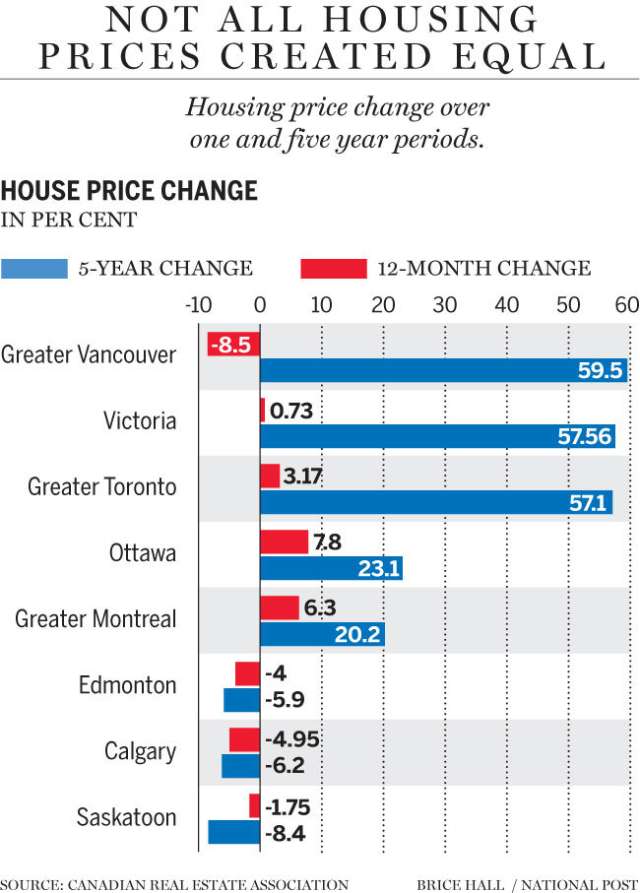
By contrast, sales continue to struggle in B.C. and prices in the urban housing markets in Alberta and Saskatchewan are now lower than they were five years ago.

Housing markets in B.C. are still moderating from stringent regulations imposed by the provincial and federal governments. Year-over-year sales in Vancouver were down by almost 30 percent in April. Residential sales in the Fraser Valley and Victoria, the other large housing markets in the province, were down by 19 and 10 percent respectively.


The MLS Composite Home Price Index (HPI) Benchmark Price, which takes into account size and structure type, reported year-over-year declines for greater Vancouver and neighbouring housing markets. HPI reported a modest year-over-year increase in Victoria.

Housing sales in markets immediately east of B.C. were higher. Calgary and Edmonton reported modest year-over-year increases whereas sales jumped by 28 and 18 per cent in Regina and Saskatoon respectively. However, the smaller size of the prairie market means that it would only take a few hundred additional sales to significantly move the needle.

Despite the increase in sales, prices are declining in Alberta and Saskatchewan. Though the magnitude of the decline in prices is lower in comparison to the ones observed in B.C., the falling housing prices have lasted much longer in the prairies than elsewhere.

Consider that housing prices in B.C., despite the recent declines, are still 60 to 80 per cent higher than they were five years ago. It’s not the same for the markets in Alberta and Saskatchewan where prices in April were lower than the prices five years ago.

Housing markets in Ottawa and Montreal are distinct from other large cities. Not only have they reported modest year-over-year increases in April —7.7 and 6.3 per cent in Ottawa and greater Montreal respectively — prices have increased moderately over the five-year horizon. The HPI in April was 23 and 20 per cent higher over five years in the two cities.

Compared to the markets in Toronto and Vancouver, Ottawa and Montreal have avoided rapid price inflations that raised alarms about housing affordability. A substantial cohort of renters, which dominates the housing market in Montreal, has likely contributed to a modest increase in demand for owner-occupied housing resulting in a moderate increase in housing prices.

By comparison, Ottawa is likely to have benefitted from the large number of federal government employees who constitute a big part of the regional labour force and whose numbers and incomes are more stable, which prevents rapid demand shocks.

Across Canada, housing sales in April were up by 4.2 per cent year-over-year. The national HPI though faltered slightly by 0.3 per cent. Higher sales in April 2019 relative to the same month last year are encouraging, but come off a relatively low reference point: sales in April 2018 were the lowest for an April in the past seven years.

The diverse spectrum of housing outcomes in large cities indicates that local housing markets are not on the same cycle. While some markets might have started to recover, others still have to experience additional moderation in sales and prices.

While it is tempting to have a one size fits all policy response to housing market challenges, one runs the risk of compounding the problems for markets needing a custom response.

Tailoring regulatory interventions to address local market needs would be a better approach.

Disclaimer and Acknowledgements: This blog post has been reproduced, with thanks, from The Financial Post’s Haider-Moranis Bulletin, courtesy of Murtaza Haider and Stephen Moranis, published on May 23, 2019.

Murtaza Haider is an associate professor at Ryerson University. Stephen Moranis is a real estate industry veteran. They can be reached at www.hmbulletin.com.


]]>
How housing is helping immigrant families close the wealth gap https://urbananalyticsinstitute.com/how-housing-is-helping-immigrant-families-close-the-wealth-gap/ Mon, 22 Apr 2019 23:48:36 +0000 https://urbananalyticsinstitute.com/?p=97 Haider-Moranis Bulletin: For immigrant families, housing alone has been the primary driver of wealth growth

The recent slump in real estate sales and prices in Canada has led some to question whether housing remains a good investment. For immigrant families in Canada, the stakes may be particularly high.

That’s because new research from Statistics Canada shows that investment in housing by immigrant families has been a major factor in helping them plug the wealth gap that exists between them and their Canadian-born compatriots.

Whereas the study found wealth growth for Canadian-born families has in recent years been driven both by increases in housing and registered pension plan assets, for immigrant families, housing alone has been the primary driver of wealth growth.

René Morissette, a senior economist with Statistics Canada, in a report released this week used data from several waves of the Survey of Financial Security to compare the wealth growth of immigrant and Canadian-born families. The designation of a family being immigrant or otherwise was based on the immigration status of the major income earner.

The report generated synthetic cohorts in order to compare similarly structured immigrant and Canadian-born families over time. The benchmark cohort comprised recent immigrant families whose primary income earner in 1999 was 25 to 44 years old and had been in Canada for fewer than 10 years. The other cohort comprised established immigrant families whose primary income earner in 2016 was 42 to 61 years old (on average 17 years older relative to 1999) and had been in Canada for 18 to 26 years. The comparable Canadian-born cohorts were of the same relative age groups.

Interestingly, while immigrant families started at lower rates of home ownership in 1999, by 2016 the homeownership rates between comparable immigrant and Canadian-born families converged.

On average, 31 percent of the benchmark cohort of recent immigrant families in 1999 owned a principal residence compared to 56 percent of comparable Canadian-born families. By 2016, established immigrant families led by a primary earner of 42 to 61 years of age reported a homeownership rate of 78.7 percent compared to 74 percent for their Canadian-born counterparts.

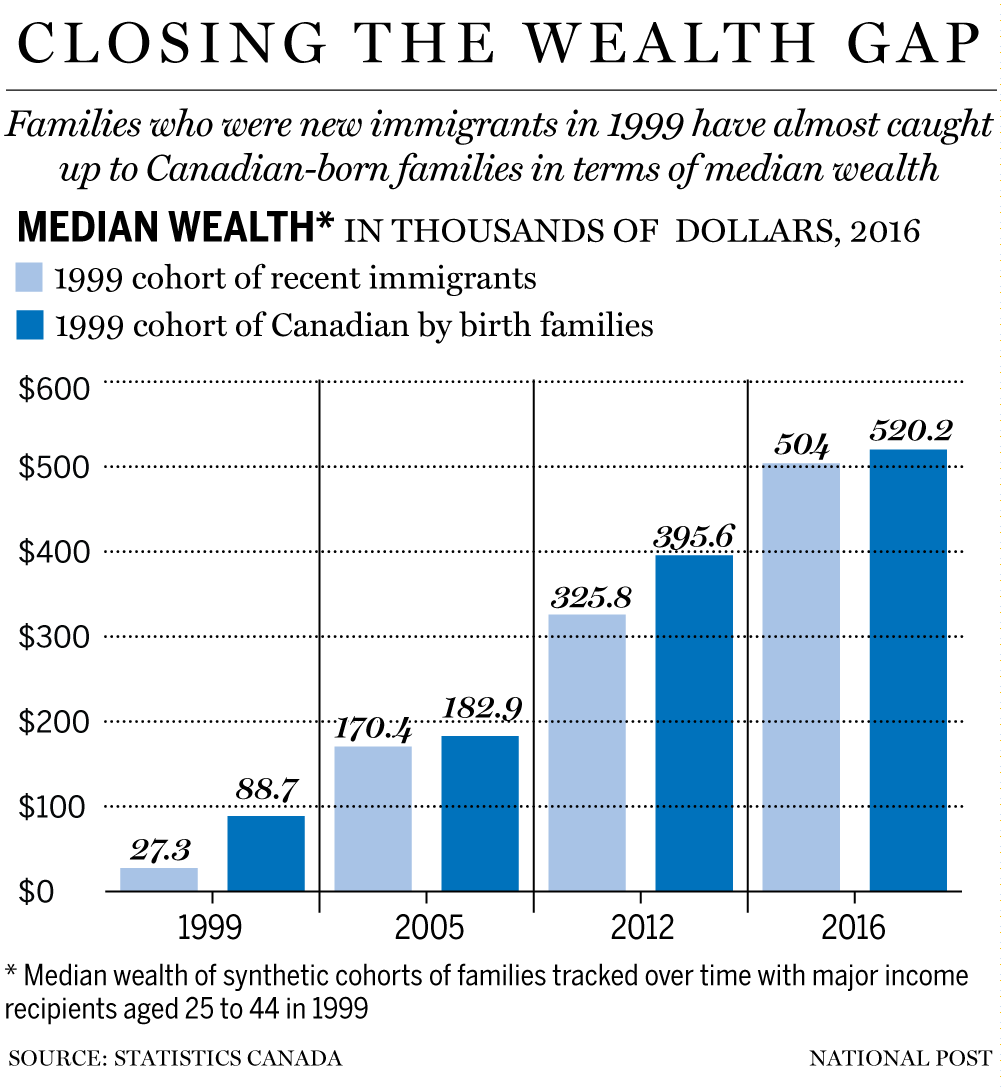
A key finding of the report is how the immigrant families caught up to their Canadian-born counterparts in growing wealth over time. In 1999, the median wealth of Canadian-born families with the major income earner aged 25 to 44 years old was 3.25 times higher than that of comparable recent immigrant families. However, when the two synthetic cohorts were compared 17 years later, the difference in median wealth between the immigrant and Canadian-born families almost disappeared.

Canadian-born and immigrant families relied on different asset classes for wealth growth. The wealth composition of families in 2016 revealed that housing equity explained about one-third of the average wealth of Canadian-born families. By comparison, housing equity was responsible for a much larger share of immigrant families’ wealth, accounting for anywhere between one-half to two-thirds.

The wealth growth observed for immigrant families has a side story of high indebtedness. The report found that in 2016, immigrant families, in general, had “markedly higher debt-to-income ratios than their Canadian-born counterparts.”

Immigrant families often, but not always, are larger in size. This is partly because immigrants are more likely to live in multi-generational households or to have siblings and their respective families occupy the same dwelling.

The unit of analysis in Statistics Canada’s report is economic family, which “consists of a group of two or more people who live in the same dwelling and are related to each other by blood, marriage, common law or adoption.” An economic family may comprise of more than one census family.

The expected differences in family size and structure between immigrants and Canadian-born families could have influenced some findings in the report. For example, the family wealth held in housing by immigrant families might lose its significance when wealth growth is compared at a per capita basis.

Housing is more than just an asset class. Homeownership provides shelter and the opportunity to grow equity over time. Canadian data shows that rising home prices over the past two decades has helped immigrants bridge the wealth gap even when the gap between the average incomes of immigrants and Canadian-born has persisted.

Disclaimer and Acknowledgements: This blog post has been reproduced, with thanks, from The Financial Post’s Haider-Moranis Bulletin, courtesy of Murtaza Haider and Stephen Moranis, published on April 18, 2019.

Murtaza Haider is an associate professor at Ryerson University. Stephen Moranis is a real estate industry veteran. They can be reached at www.hmbulletin.com

]]>