The brief below explains the current challenges in construction activity facing headwinds in Canada’s most populous provinces: Ontario and Alberta. It further examines the recent growth in residential construction in British Columbia and Alberta, which also face similar growth-restricting challenges but have been able to expand the construction of residential dwellings.
Toronto’s Construction Decline: An Overstated Concern? by Murtaza Haider
]]>Leveraging the insights of 24 politicians and industry experts alongside the contributions of 100 delegates from diverse sectors including government, business, unions, academia, and non-governmental organizations, the summit aims to rigorously evaluate the economic, environmental, and social advantages of enhanced transit systems.
The summit is poised to generate strategic recommendations intended to illuminate a path forward, thereby ensuring that the future trajectory of Toronto’s transit system markedly surpasses its recent historical challenges. Stakeholders and interested parties are encouraged to engage in this critical discourse, which promises to be at the forefront of shaping the region’s transit landscape.
]]>Urban planning literature and bicycle enthusiasts in North America always draw attention to the widespread use of bicycles in the Netherlands, where bicycles are an efficient mode of travel that competes with cars and public transit. The Dutch demographics are unique, as are the climate and other enabling factors, such as the older age of the built environment constructed before the War for non-motorized modes, preferential design for bicycle infrastructure in the newly developed neighbourhoods, and relatively flat terrain.
Consider that both Montreal and Amsterdam are located on islands. However, Amsterdam is distinguished for its flat, low-lying areas, while Montreal is known for its most prominent feature, Mount Royal. For cycling, flatness helps, but mountains don’t.
Remember how different these cities are in climate. The average temperature in Amsterdam ranges from 3.5 degrees Celsius in January to 18 degrees in July. Montreal has freezing weather. The average temperature in January is minus 9 degrees Celsius. The mercury regularly reaches north of 25 degrees Celsius in summer. To make this more interesting, Montreal gets tons of snow. There are two things cyclists struggle the most with within Canada: streetcar tracks and snow.
And if you didn’t know, Amsterdam hardly gets any snow that lasts on road surfaces.
More traffic deaths in 2022, particularly among cyclists over 75
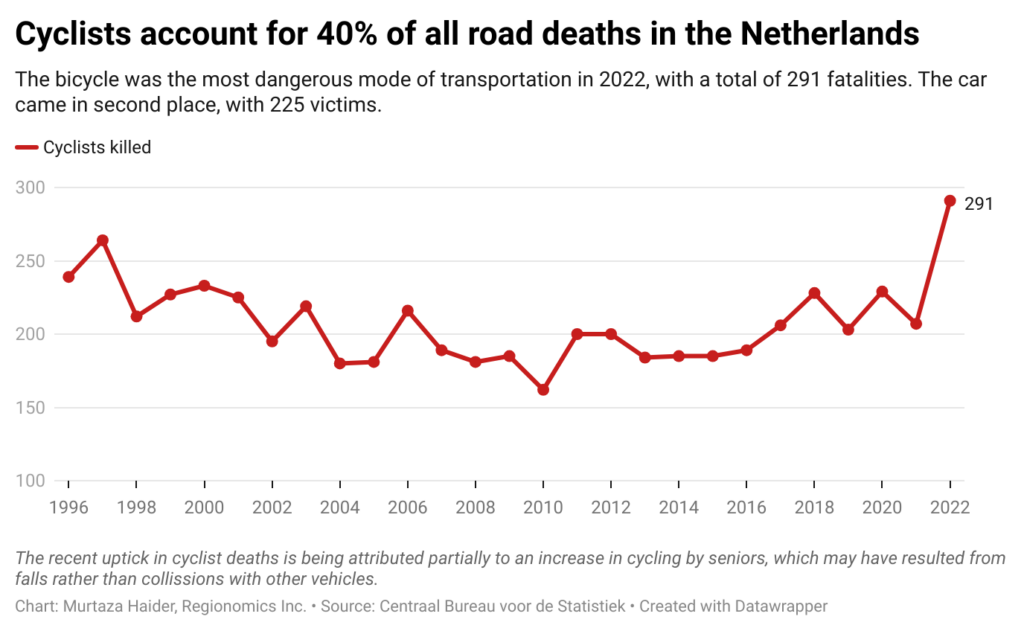
Earlier in April 2023, Statistics Netherlands reported increased road deaths in 2022. The main contributor to the growth in fatalities was cyclists over the age of 75. While fatalities increased in 2022 for cyclists and car occupants, the jump was more pronounced for cyclists. In 2022, cyclist deaths increased by 84 and car occupants by 50. The 21 percent increase in road deaths in 2022 over the previous year comprised mostly men, who accounted for 522 deaths.
Road deaths rose the most among seniors aged 75 and over in the Netherlands. Relative to 2021, deaths amongst seniors increased by 59 percent in 2022. Statistics Netherlands noted that “traffic victims aged 50 years and over are relatively likely to be involved in a bicycle accident, while younger victims (under 50) are more likely to be killed in a car accident. In relative terms as well, the number of senior cyclists involved in a fatal road accident increased.”
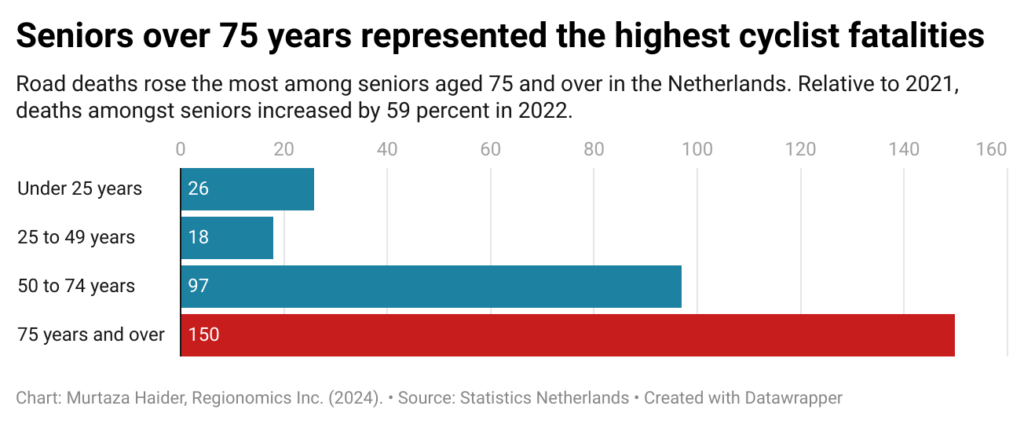
Collisions with motorized vehicles were responsible for three-fourths of all cyclist deaths in the Netherlands in 2022. Collisions with passenger cars or vans accounted for half of all cyclist deaths. “One quarter of all bicycle deaths were not due to a collision. These cyclists died after a fall, due to becoming unwell, wrong steering, bad road surface, slipperiness, or a foot between the spokes, among other things. Over two thirds of these victims were 70 years of age or older,” noted Statistics Netherlands.
Bicycle is a healthier mode of travel for individuals and the planet. It costs less to install bicycle infrastructure than road and transit infrastructure. Yet, it might only be a feasible mode of travel for some demographics and places. Its wholesale adaption as a mode of travel comes with huge risks. The cycling enthusiasts and planners advocating for its mass adoption seldom mention the risks, which are considerable given that cyclists account for 40 percent of all road deaths in the Netherlands.
Collision or fall are not the only risks cyclists face more than those using other modes of travel. The financial risk is also at play. Since cycling can be done safely for shorter distances than by cars or public transit, those who adopt bicycles to work in North America will limit their employment or residence options. Cyclist commuters must find work near home or home near work. This restricts choice sets for employment and residence, resulting in suboptimal choices.
The bicycle mode share can be expanded by providing safe infrastructure for cyclists in Canada. Yet, the Dutch experience in road safety must not be overlooked, where cyclists represent 40 percent of all road fatalities.
- Crime is more frequent on subway stations than subway trains or buses.
- Crime is more prevalent on terminal transit stations or transfer stations (Yonge and Bloor) where commuter volumes are high.
- Crime on public transit increased when transit ridership declined during the pandemic.
Prof. Haider recommended that the TTC consider increasing vigilance and monitoring of transit stations in the downtown core and other transit stations where transit ridership are notably higher. We have already identified those stations to be in downtown Toronto or the terminal points of transit lines. We would also recommend the use of artificial intelligence-based technologies that can readily be mounted on existing video feeds collected by cameras on TTC property and vehicles. For instance, ZeroEyes provides technology that can identify in real-time from the video feeds if weapons were brandished, subsequently alerting the police and other security personnel.
You can read the commentary on LinkedIn by clicking HERE.
]]>You can read the Column in the December 06 issue of the Financial Post.
]]>To register for the event, please visit https://www.torontomu.ca/city-building/events/2022/11/national-housing-deficit-webinar/.
Addressing the National Housing Deficit with Urban Analytics Institute
The Urban Analytics Institute at Toronto Metropolitan University researches data-driven solutions to urban issues, producing insights on a variety of topics, focused mainly on real estate and housing economics, consumer finance and smart cities. Its current research explores the future of urban transportation given the broad switch to telework, and ways to increase housing supply in Canada and restore affordability.
In this session led by Dr. Murtaza Haider (Professor, Real Estate Management, TRSM), we will discuss UAI’s comprehensive review of the reasons behind the accumulation of a national housing deficit approaching four million dwelling units, and the changes in policy, strategies and designs needed to build housing at scale, with Assistant Professors in Real Estate Management Dr. Kiana Basiri and Dr. Anson Ho, and research associate Meet Shah.
We will be ending this session promptly to allow attendees to commemorate Remembrance Day.
]]>The six-member expert panel, jointly commissioned by the Federal and B.C. governments, went beyond the oft-cited demand-curbing recommendations of higher transfer taxes and penalties. Instead, the panel focused on the lack of housing supply in B.C., and the lucklustre efforts to address it.
Read further in The Financial Post.
]]>The presentation was made at the 2020 BOMA NXTEK Forum.
You can watch the brief video at https://youtu.be/tPZZOLuzXSQ.
]]>“Rental markets are showing signs of weakness, with rents falling and vacancies climbing, particularly in and around the downtown cores.
“From Manhattan to Toronto, and San Francisco to Vancouver, rental markets are transacting at a discount, which is what many of those priced out of centrally located communities need to find digs in choice neighbourhoods.
“Take the Greater Toronto Area. The average rent for a one-bedroom apartment was down by 11.1 per cent in the third quarter from a year earlier, according to the recently released Q3 rental market report by the Toronto Regional Real Estate Board (TRREB).
“The recent shift could be troubling for landlords that have enjoyed years of escalating rents and falling vacancy rates, but the decline in average rents has brought many new renters to the market. Apartment rentals in the third quarter were up by 30.2 per cent from a year earlier.”
]]>Professor Madhav Badami at McGill University and colleagues invite expressions of interest in pursuing doctoral research that will critically investigate the political economy of urban transport decision-making and financing in India.
The rapid growth in motorization and its impacts in Indian cities has been sought to be addressed by means of projects such as road widening, grade-separated intersections, limited access highways, and rail-based rapid transit systems. These projects, while often seen as bringing in a world-class orientation to urban transportation, also raise questions about their efficacy among other issues, because of their high capital requirements, inability to cater to a wide section of society, and the potential to reinforce existing urban exclusions.
The accepted PhD student will have the opportunity to investigate how and why decisions to implement and finance such projects were made, and their implications for urban transport outcomes. The PhD student will be part of the Social Science and Humanities Research Council (SSHRC), Canada funded project titled Constituting Urban Indian Mobility. The project research team comprises Professors Govind Gopakumar (Concordia University), Madhav G. Badami (McGill University), Craig Townsend (Concordia University), Sarah Turner (McGill University), and Rutul Joshi (CEPT University).
The student selected for the research will be helped to put together an application package for admission to the doctoral programme in Urban Policy, Planning and Design in the School of Urban Planning at McGill University. If the student is admitted to this programme, s(he) will be nominated for fellowships and other funding to support the doctoral studies and field-work.
Qualifications
The research team is seeking a candidate with a Master’s degree, an excellent academic background, including skills in qualitative and quantitative analysis, and ideally, a proven track record in research relevant to the topic.
Those interested should email Madhav G. Badami (at madhav.badami@mcgill.ca) and Govind Gopakumar (at govind.gopakumar@concordia.ca) latest by December 1, 2020, explaining why they are interested in and suitable for this doctoral research programme. The following materials should be attached: a CV, including qualifications, and names of two academic referees; an unofficial academic transcript; and one or two samples of critical, analytical writing (including published articles), that will allow assessment of suitability. We will hold Zoom interviews with short-listed applicants in early December.
]]>